Yamaha vs Honda Motorcycles and How the Two Biggest Brands Actually Stack Up
Mar 14, 2026
Tags:guiderentershondaownersyamaha
Honda and Yamaha sell more motorcycles combined than any other two manufacturers on the planet. Honda moved 20.7 million units globally in 2025 and holds roughly 40% of the worldwide motorcycle market, while Yamaha sold 4.8 million units and ranks as the third largest motorcycle manufacturer in the world behind Honda and Hero.
When riders start comparing Yamaha vs. Honda, the question isn't which brand makes better bikes. It's which engineering philosophy matches the way you actually want to ride. We'll break that down below with 2026 model matchups, updated MSRPs, and the numbers that matter when you're making a decision.
Honda vs. Yamaha Motorcycles by the Numbers
If you're trying to figure out which is the best Japanese motorcycle brand for your next bike, it helps to see where each one stands heading into 2026:
Honda in 2026
- 20.7 million motorcycles sold globally in 2025, an all-time record
- Roughly 40% of the global motorcycle market, with a stated goal of reaching 50% by 2030
- 500 million cumulative motorcycles produced as of May 2025, a milestone 76 years in the making
- Approximately 1,075 powersports dealerships in the U.S.
Yamaha in 2026
- 4.8 million motorcycles sold globally in 2025
- Third largest motorcycle manufacturer in the world behind Honda and Hero
- Approximately 865 motorcycle dealerships in the U.S.
How Honda and Yamaha Build Motorcycles Differently
Those sales numbers tell you both brands have massive global reach, but they don't tell you much about how the bikes actually feel once you're riding them. That's where things start to split.
Honda's Approach
Honda's engineering has always leaned toward making every ride as smooth and accessible as possible. They pioneered fuel injection on production motorcycles, developed the dual clutch transmission, and now lead the industry with E-Clutch. That system debuted in 2024 on the CB650R and CBR650R as the first Honda motorcycles to feature it, and it automates clutch operation while still letting you use the lever manually whenever you want. It's a good example of Honda's broader philosophy: remove friction from the riding experience so you can focus on the road.
Yamaha's Approach
Yamaha takes the opposite stance and builds motorcycles around the idea that feeling connected to the machine is the whole point. Their crossplane crankshaft concept, the CP2 platform behind the MT-07, YZF-R7, and Tenere 700, uses a 270-degree firing order that creates an immediate connection between your right hand and the rear tire. Where Honda works to smooth things out, Yamaha wants you to feel the engine working underneath you.
Where They Overlap
Both Honda and Yamaha build reliable, well-supported motorcycles with strong resale value and massive aftermarket parts availability, so the fundamentals are covered no matter which brand you go with. The difference really comes down to feel: Honda rides like a bike that's been engineered to work on your behalf, while Yamaha rides like a bike that's asking you to push a little harder.
Honda vs. Yamaha Comparison (2026 Models)
The 2026 lineup brought some interesting pricing shifts from both brands. Honda dropped the MSRP on the CB650R and CBR650R by $700 each, while Yamaha loaded the YZF-R7 with a full electronics overhaul. We'll walk through all three matchups below:
- Yamaha MT-07 vs. Honda CB650R E-Clutch
- Yamaha YZF-R7 vs. Honda CBR650R E-Clutch
- Yamaha Tenere 700 vs. Honda Africa Twin
Yamaha MT-07 vs. Honda CB650R E-Clutch
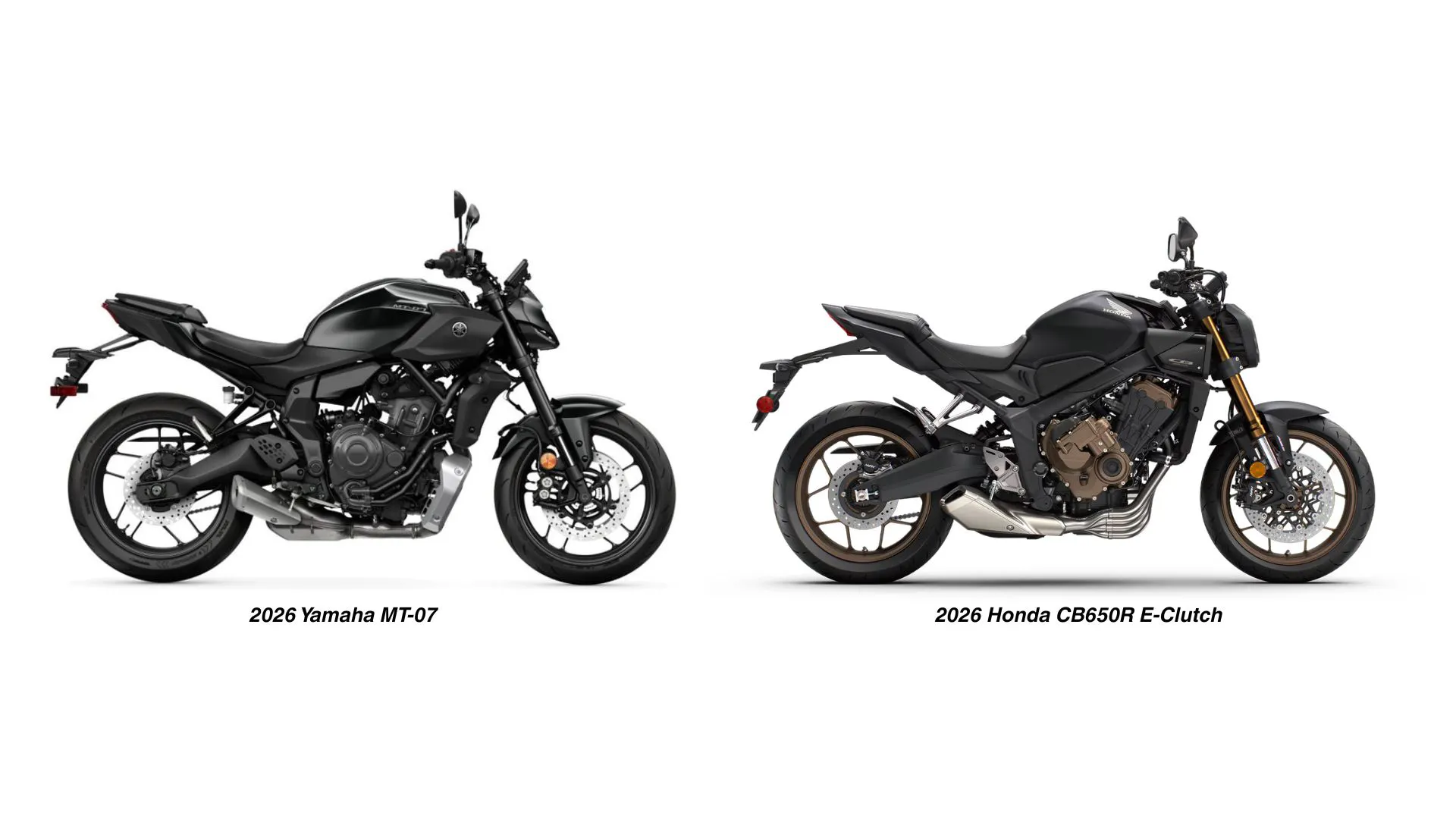
These two middleweights are priced within $100 of each other for 2026, but the riding experience they deliver couldn't be more different.
2026 Yamaha MT-07
The MT-07 runs Yamaha's 689cc CP2 twin, the same crossplane crankshaft platform that powers the R7 and Tenere 700, making about 72 hp with most of its power concentrated in the low and mid range. Yamaha also gave it a solid round of updates for 2026:
- Radially mounted front brakes and 41mm inverted forks
- SpinForged wheels and a full-color TFT display
- Yamaha Ride Control with 3 throttle maps and switchable traction control
- Y-Connect smartphone connectivity with Garmin StreetCross navigation
2026 Honda CB650R E-Clutch
The CB650R goes a completely different direction with a 649cc inline four making 94 hp that gets better the higher you rev it. Honda's E-Clutch comes standard, letting you shift without the clutch lever or use it traditionally at any time. The 2026 MSRP dropped $700 from last year, making this the most accessible the CB650R has ever been.
On the Road
The MT-07 is the lighter bike with a twin-cylinder pull you notice through every gear, while the CB650R is smoother and more composed with a four-cylinder that loves to rev and a clutch system that takes the effort out of stop-and-go riding. At this price point, you're really choosing between a bike that wants your attention and a bike that wants to make your life easier.
Is a Yamaha MT-07 Better Than a Honda CB650R?
The Yamaha MT-07 is the better choice for riders who want a lighter, more connected ride where every input feels immediate. The Honda CB650R is the better pick if you prefer a smooth, high-revving engine and the daily convenience of E-Clutch. Both are excellent middleweights at nearly the same price, and the right answer depends on whether you care more about how the bike feels or how easy it is to live with every day.
Yamaha YZF-R7 vs. Honda CBR650R E-Clutch
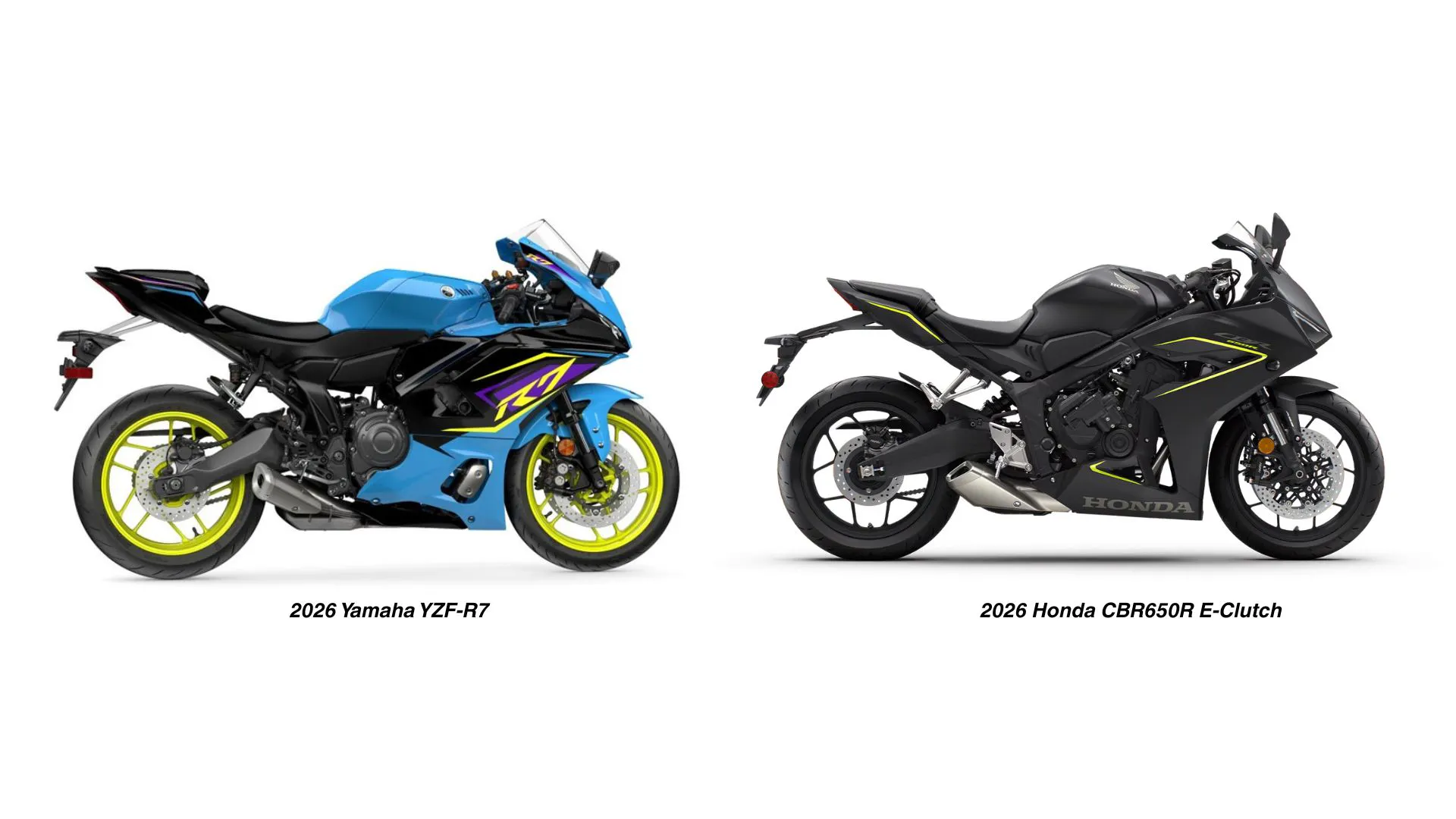
Yamaha gave the R7 a ground-up overhaul for 2026 while Honda made the CBR650R more affordable than ever. Both moves made this matchup a lot more interesting than it was last year.
2026 Yamaha YZF-R7
The biggest change for 2026 is that Yamaha added a 6-axis IMU to a middleweight sportbike for the first time, borrowed directly from the YZF-R1. That IMU is what powers the R7's new electronics package:
- Traction control, slide control, and lift control
- Launch control, brake control, and engine brake management
- 3rd-gen Quick Shift System for clutchless shifts in both directions
- Redesigned frame with new aero styling and integrated winglets
2026 Honda CBR650R E-Clutch
The CBR650R doesn't match the R7's electronics, but it makes up ground with 94 hp from its inline four (compared to the R7's 72 hp), Showa SFF-BP front forks, and Honda E-Clutch standard. Honda dropped the MSRP $700 from 2025, putting the CBR650R $200 under the R7 for the first time.
Choosing Between the Two
If track days and canyon riding are part of your plans, the R7's IMU and lean-sensitive aids give it a clear advantage. If you want a sportbike that works just as well on your weekday commute, with more peak power and clutchless convenience, the CBR650R is the better option.
Yamaha Tenere 700 vs. Honda Africa Twin
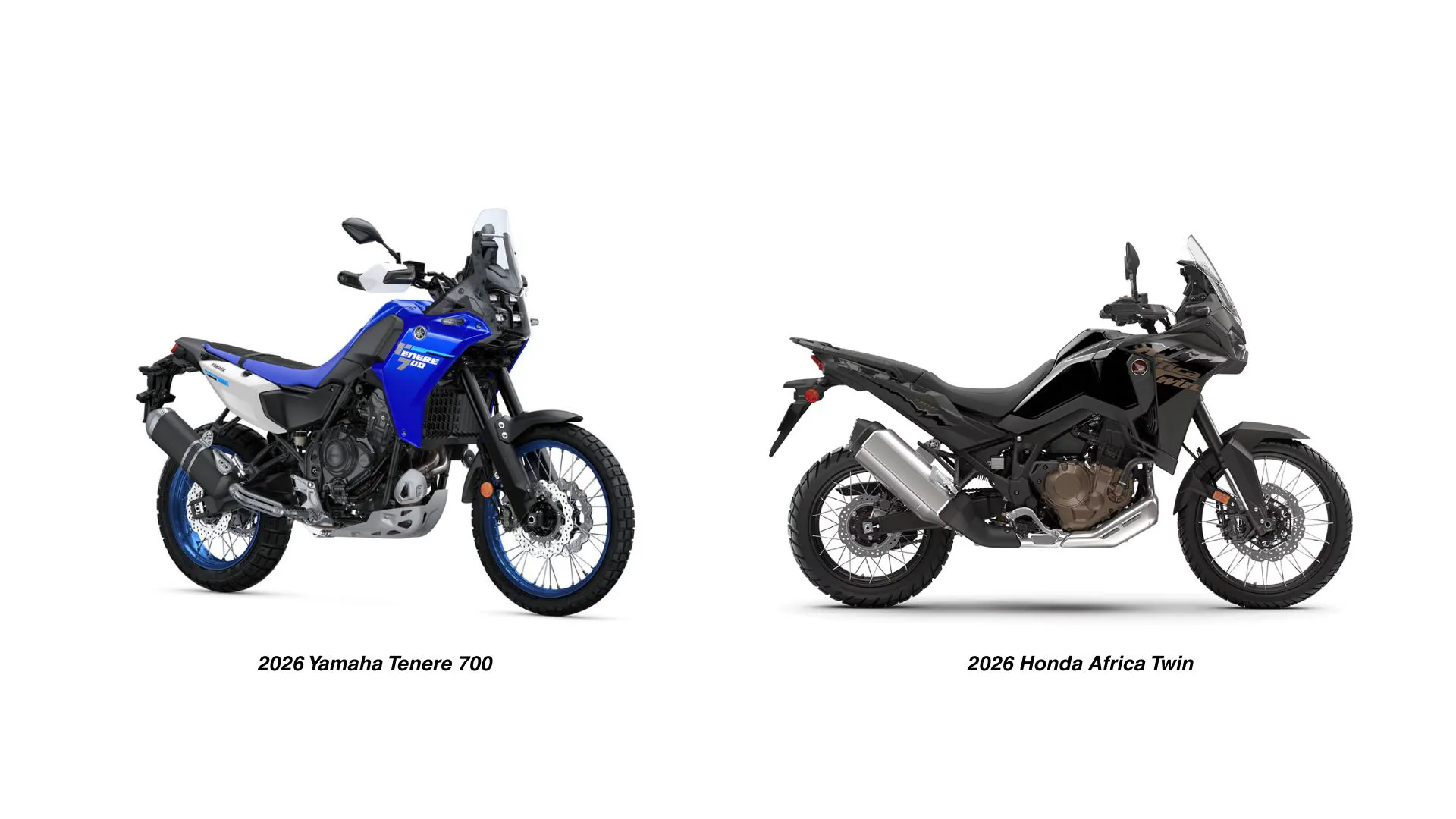
The adventure category is where these two brands' engineering philosophies are the most obvious, and the right pick has more to do with how you plan to ride than which bike looks better on paper.
2026 Yamaha Tenere 700
The Tenere 700 runs the same 689cc CP2 twin as the MT-07 and R7, paired with a lightweight chassis, a 21-inch front wheel, and YCC-T ride-by-wire with two ride modes and switchable traction control. Yamaha is also bringing the Tenere 700 World Raid to the U.S. for the first time at $12,999, adding:
- Dual 6.1-gallon fuel tanks for 300+ mile range
- 6-axis IMU with lean-sensitive traction control, slide control, and ABS
- Fully adjustable 46mm KYB forks with increased wheel travel
- Cruise control and a larger TFT display with Bluetooth connectivity
2026 Honda Africa Twin
The Africa Twin is a completely different class of machine with a 1,084cc Unicam twin making about 100 hp. It comes loaded from the factory with features the Tenere doesn't offer at base:
- 6-axis IMU with 6 ride modes, 7-level HSTC, and 3-mode ABS
- 6.5-inch touchscreen TFT with Apple CarPlay and Android Auto
- Cruise control standard across the entire lineup
- Manual or DCT transmission ($15,999), Adventure Sports ES from $17,799 with electronic suspension and a 6.6-gallon tank
Two Very Different Kinds of Adventure
The Tenere 700 costs about $4,200 less and is the lighter, more agile option for riders who want to get into technical off-road terrain. The Africa Twin brings more power, more technology, and the kind of comfort you'll appreciate when you're packed up for multi-day rides on the highway.
2026 Pricing Side-by-Side
All prices listed are manufacturer's suggested retail price (MSRP) and do not include taxes, dealer fees, freight, or destination charges. Actual out-the-door pricing will vary by dealership.
Yamaha 2026 MSRPs
- MT-03: $4,999
- YZF-R3: $5,499
- MT-07: $8,599
- XSR700: $8,599
- YZF-R7: $9,399
- MT-09: $10,899
- Tenere 700: $10,999
- Tenere 700 World Raid: $12,999
Honda 2026 MSRPs
- CB300R: $4,499
- Rebel 300 E-Clutch: $5,349
- Rebel 500: $6,799
- CB650R E-Clutch: $8,699
- CBR650R E-Clutch: $9,199
- Africa Twin (manual): $15,199
- Africa Twin DCT: $15,999
Is Yamaha or Honda More Reliable?
Both Yamaha and Honda are among the most reliable motorcycle manufacturers you can buy, and there isn't a clear loser to point to here. Both brands have earned their reputations over decades, and the numbers back that up.
Yamaha's Reliability
- CP2 engine platform has a strong owner-reported durability track record across the MT, R, and Tenere lines
- Crossplane crankshaft design reduces vibration and internal stress on engine components, contributing to longer engine life
- Forged pistons standard across the lineup, offering a longer lifespan than cast alternatives
Honda's Reliability
- Engines routinely run past 50,000 miles with scheduled maintenance alone
- 500 million cumulative motorcycles produced since 1949, reflecting manufacturing consistency that only comes with decades of refinement
- First motorcycle manufacturer to introduce a production airbag system and ABS across its full lineup
Yamaha vs. Honda Reliability Ratings
The most widely referenced motorcycle reliability data comes from a Consumer Reports survey** of over 11,000 riders on more than 12,300 motorcycles, measuring the percentage of bikes that needed a repair within the first four years of ownership.
- Yamaha: 11% four-year failure rate, the lowest of any brand surveyed
- Honda: 12% four-year failure rate
- Suzuki: 15% four-year failure rate
- Kawasaki: 15% four-year failure rate
- Harley-Davidson: 26% four-year failure rate
- BMW: 40% four-year failure rate
Both Yamaha and Honda came in at roughly half the 24% industry-wide average. About 75% of repairs during those first four years cost less than $200 out of pocket, and most were minor electrical or accessory issues rather than engine or transmission failures.
**This data covers model years 2008 through 2014. No comparable large-scale motorcycle reliability survey has been published since, but the rankings remain consistent with current owner-reported experiences across the motorcycle community.
Are Yamaha Parts Cheaper Than Honda?
Yes, Yamaha OEM parts for routine maintenance like brake pads, chains, filters, and sprockets tend to cost slightly less than Honda's equivalent pricing. Honda makes up for that with a larger dealer network (about 200 more U.S. locations than Yamaha), which means sourcing specific OEM components is usually faster on the Honda side. Both brands have massive aftermarket ecosystems that keep third-party parts competitive regardless of which bike you ride.
The Bottom Line on Reliability
A well-maintained Yamaha will last just as long as a well-maintained Honda, and this isn't a comparison where you need to worry about making the wrong call. From an engine and build quality standpoint, both brands deliver the kind of longevity that keeps riders coming back.
Which Brand Holds Its Value Better, Yamaha or Honda?
Honda holds its value better than Yamaha across most of the lineup, and a lot of that traces back to the reliability reputation we just covered. A larger U.S. dealer network creates more demand on the used market, and Honda's name recognition makes buyers more willing to pay closer to asking price. Yamaha's MT-07 and Tenere 700 are the exceptions because owners tend to hold onto them longer than average, which keeps used pricing strong for both models. Outside of those, Honda is the better choice if resale value matters to you.
Are Yamaha and Honda Engines the Same?
No, Yamaha and Honda engines are not the same, even when they share a similar displacement. You can feel the difference within the first few minutes of riding.
Yamaha's CP2 Twin
Yamaha's 689cc twin uses a crossplane crankshaft with a 270-degree firing order, meaning the pistons fire at uneven intervals instead of evenly spaced ones. That uneven pulse is what gives the CP2 its distinct feel and the sense of direct connection between your inputs and the rear wheel. The same engine powers the MT-07, YZF-R7, Tenere 700, and XSR700.
Honda's Engine Lineup
Honda uses different engine architectures depending on the category. The CB650R and CBR650R run a 649cc inline four that delivers smooth, even power and rewards you for revving it out. The Africa Twin goes in a completely different direction with a 1,084cc Unicam parallel twin built around broad, usable torque for loaded touring.
Which Is Better for Beginners, Yamaha or Honda?
Both Yamaha and Honda offer some of the strongest beginner motorcycle lineups in 2026, and either brand will set you up well for learning to ride. The things that matter most when you're starting out are a low seat height that lets you put your feet flat on the ground, manageable power that builds your confidence without overwhelming you, and a price point that doesn't stretch your budget before you've even bought your first set of gear.
Honda's Beginner Standouts
- Rebel 300 E-Clutch at $5,349: low 27.2-inch seat, E-Clutch eliminates stalling
- CB300R at $4,499: lightweight, manageable 286cc single
- CBR500R at $6,399: approachable power with sport-bike styling
Yamaha's Beginner Standouts
- MT-03 at $4,999: upright riding position, smooth 321cc twin
- YZF-R3 at $5,499: one of the most capable entry-level sportbikes available
So, Yamaha or Honda for Beginners?
Honda's E-Clutch gives the brand an advantage for first-time riders because stalling is the biggest confidence killer when you're learning, and E-Clutch removes it entirely. Yamaha's beginner bikes tend to run slightly more affordable and deliver an engaging ride from day one.
Browse Yamaha, Honda, & 15+ Motorcycle Brands on Riders Share
The best way to settle the Yamaha vs. Honda debate is to stop reading about it and start riding. A motorcycle rental through Riders Share lets you book from real owners near you and put a bike through your actual riding conditions before you commit to buying anything.
Rent a Yamaha Motorcycle
If the MT-07's twin-cylinder character or the R7's new electronics package caught your eye, a Yamaha motorcycle rental on Riders Share is the fastest way to find out if it lives up to the hype. Browse available Yamaha rentals starting at $23/day and get real seat time on the bike you're considering.

Rent a Honda Motorcycle
If Honda's E-Clutch convenience or the Africa Twin's touring capability sounds more like your speed, a Honda motorcycle rental lets you experience it firsthand without the dealership pressure. Browse available Honda rentals starting at $23/day and see how it feels on your roads, your commute, and your schedule.
Conclusion
The decision between these two brands comes down to what kind of rider you are. If you want a bike that smooths out the rough edges and makes every ride feel effortless, Honda has built their entire 2026 lineup around that idea. If you want a bike that rewards your inputs and makes you feel like an active part of the experience, that's what Yamaha has been doing since 1955.
Related Articles
Mon - Fri: 8-8 CT
Weekends: 9-8 CT
