Motorcycle Helmet Laws by State 2025: Universal, Partial & No-Law States
Jan 20, 2026
Tags:renterlisting-tipsownertips
Motorcycle helmet laws change the moment you cross a state line, which means a ride that starts helmet-optional can turn into a ticket the second you hit a new border. If you're renting a bike for a weekend trip or planning a cross-country route, knowing which states require motorcycle helmets keeps you legal and fine-free wherever the road takes you. This guide covers all 50 states so you can check the rules before you ride.
Disclaimer: Riders Share promotes safe riding practices and strongly recommends that all riders wear a motorcycle helmet, regardless of local laws. We believe in putting safety first to ensure an enjoyable riding experience for everyone.
How States Handle Motorcycle Helmet Laws in 2025
The country splits into three categories when it comes to motorcycle helmet requirements:
- Universal Helmet Law States (19 states + DC): All riders and passengers must wear a DOT-certified helmet, no exceptions
- Partial Helmet Law States (28 states): Helmets required for riders under a certain age, with some states offering insurance or training exemptions for adults
- No Helmet Law States (3 states): Illinois, Iowa, and New Hampshire have no requirements for any riders
Helmet Law Map
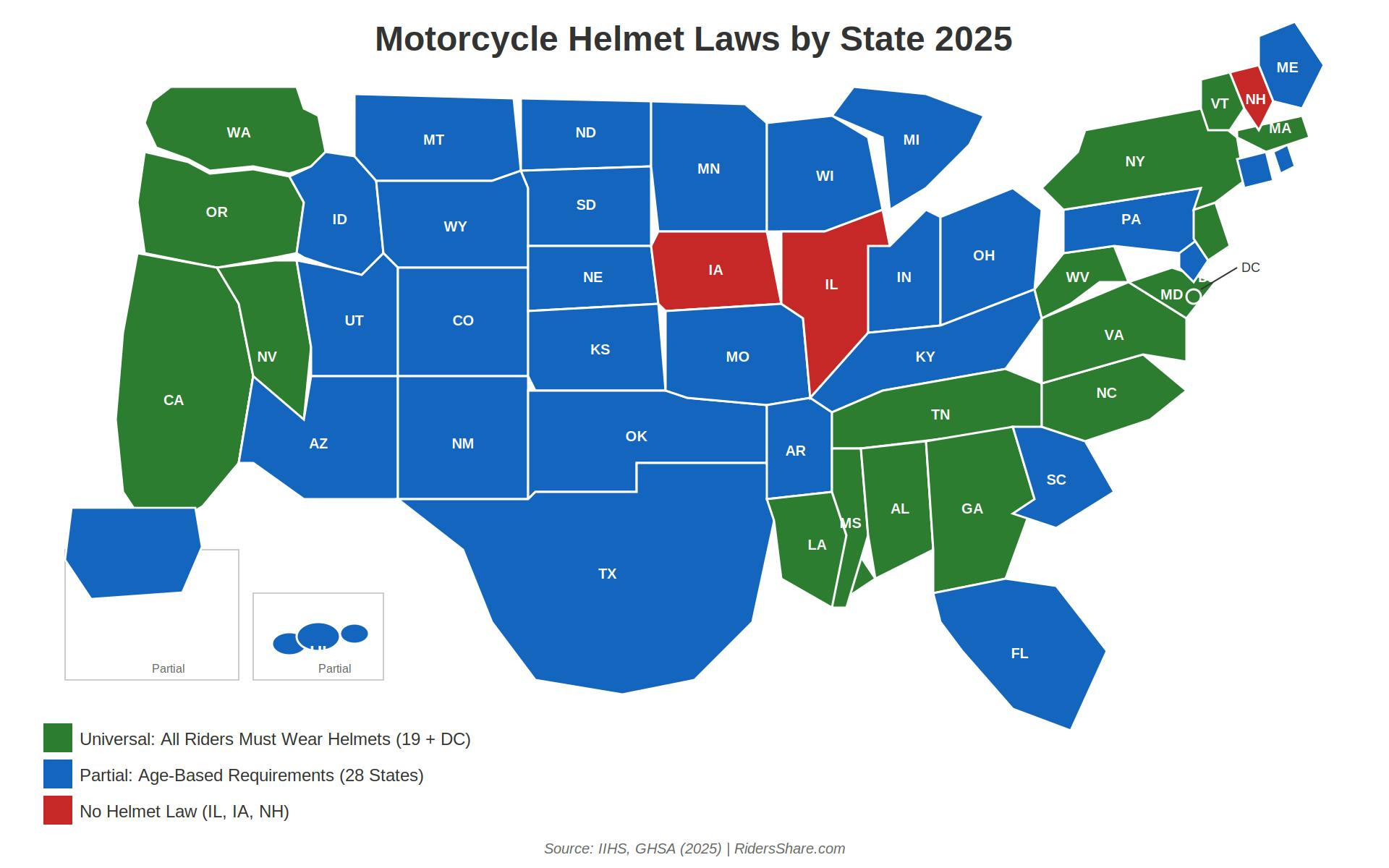
Universal Helmet Law States
19 states (+ Washington, D.C.) require helmets for all riders and passengers at all times, and there's no way around it regardless of your age, experience, or insurance coverage:
- Alabama
- California
- District of Columbia
- Georgia (mopeds under 50cc exempt)
- Louisiana
- Maryland
- Massachusetts
- Mississippi
- Nevada
- New Jersey
- New York
- North Carolina
- Oregon
- Tennessee
- Vermont
- Virginia
- Washington
- West Virginia
Helmet use in these universal helmet law states reaches 84%, compared to just 54% in states without these laws.
Partial Helmet Law States With Age Requirements
28 states in the U.S. fall into this middle ground, where motorcycle helmet requirements depend on the rider's age. Some states also offer exemptions for adults who meet insurance or training requirements, so the rules can get specific depending on where you're riding.
States Requiring Helmets for Riders Under 18
18 states require helmets for riders 17 and younger:
- Alaska (also all passengers and permit holders)
- Arizona
- Colorado (passengers under 18 too)
- Hawaii
- Idaho
- Indiana
- Kansas
- Maine (also first year of licensure and permit holders)
- Minnesota (also permit holders)
- Montana
- New Mexico
- North Dakota (passengers of covered operators too)
- Ohio (also first year of licensure)
- Oklahoma
- South Dakota
- Wisconsin (also permit holders)
- Wyoming
States Requiring Helmets for Riders Under 21
Nine states require helmets for riders 20 and younger:
- Arkansas
- Connecticut
- Florida (21+ can ride without helmet if carrying $10,000 medical insurance)
- Kentucky (also permit holders of any age)
- Michigan (21+ exempt with insurance + safety course or 2 years experience)
- Nebraska (21+ exempt after completing MSF eCourse)
- Pennsylvania (21+ exempt with safety course or 2 years experience)
- Rhode Island (also first year of licensure and all passengers)
- South Carolina
- Texas (21+ exempt with safety course OR medical insurance)
- Utah
Other Age Requirements
- Delaware: Helmets required for riders under 19, plus the first 2 years after getting your endorsement
- Missouri: Helmets required for riders under 26, and riders 26+ need to carry proof of financial responsibility
States with Insurance or Training Exemptions
Five states let riders skip the helmet if they meet specific requirements, but you'll need to carry documentation if you plan to ride without one:
- Florida
- Texas
- Pennsylvania
- Michigan
- Nebraska
Florida Helmet Law (Exemption)
Riders 21 and older can go without a helmet if they carry at least $10,000 in medical insurance coverage for motorcycle injuries. Riders under 21 must always wear a helmet, and everyone needs eye protection regardless of age.
Texas Helmet Law (Exemption)
Riders 21 and older are exempt if they show proof of completing a motorcycle safety course or proof of medical insurance. Officers can't stop you just to check your exemption status, but they can ask for documentation during other stops.
Pennsylvania Helmet Law (Exemption)
Riders 21 and older are exempt if they have at least two years of riding experience or have completed a PennDOT or Motorcycle Safety Foundation approved safety course.
Michigan Helmet Law (Exemption)
Riders 21 and older can opt out if they carry additional insurance and have either passed a motorcycle safety course or held their endorsement for at least two years. Passengers using this exemption need to meet the same requirements.
Nebraska Helmet Law (Exemption)
Riders 21 and older can ride without a helmet if they hold a Nebraska Class M license and complete the Motorcycle Safety Foundation Basic eCourse, with proof of completion submitted to the DMV.
States With No Motorcycle Helmet Law
Only three states have no motorcycle helmet law for any riders or passengers, making them the only places in the country where adults face zero legal helmet requirements.
- Illinois: no helmet requirement for riders or passengers of any age, though you'll still need eye protection unless your motorcycle has a windshield.
- Iowa: doesn't require helmets for any riders. The state actually had a universal helmet law from 1975 to 1976 before repealing it, and around 74% of motorcycle fatalities in recent years have involved unhelmeted riders.
- New Hampshire: Following the state motto "Live Free or Die," New Hampshire has never had a motorcycle helmet law for any age group.
DOT-Certified Motorcycle Helmet Requirements 2025
In states that require helmets, your gear needs to meet Federal Motor Vehicle Safety Standard (FMVSS) No. 218, which is called DOT certification. Helmets that skip this certification won't protect you in a crash and won't hold up if you get pulled over. Here's what makes a helmet DOT-certified:
- Hard exterior shell
- Impact-absorbing liner
- Retention system (chin strap)
- Adequate head coverage
You can check for the DOT sticker on the back of the helmet to confirm it meets the standard. Some riders also look for Snell or ECE certifications for extra peace of mind, but most states only require DOT.
Why Wearing a Motorcycle Helmet Matters
There’s a reason why wearing a motorcycle helmet is a legal requirement in most states, and that’s mainly because it greatly improves your chances of surviving a motorcycle crash. Helmets are estimated to be 37% effective in preventing fatal injuries to motorcycle drivers. This protective gear helps guard against severe head injuries and increases visibility and protection from the elements, making every ride safer.
Ride Safely with a Motorcycle Rental from Riders Share
At Riders Share, safety is our top priority. Whether you're heading out on a short trip or a long adventure, we always encourage our riders to wear helmets. Many owners on Riders Share offer complimentary helmet or gear rentals for a small fee. By choosing our motorcycle rentals, you're opting for a safer riding experience. Comply with local helmet laws and enhance your protection on every ride. Rent a motorcycle with Riders Share and make every journey safe and memorable!

Helmet Requirements for Motorcycle Renters
If you're renting through Riders Share, you're responsible for following the helmet laws of every state on your route, and requirements can change multiple times on a single trip.
Before You Book
- Map out your route and note which states you'll pass through
- Check whether any state on your path has a universal helmet law
- Ask your host about helmet availability when booking
What Most Owners Offer
Many Riders Share owners include helmets with their rentals or offer them as add-ons for a small fee. When you're browsing listings, check for the gear icon that will be placed alongside each bike listed (if owners are renting gear) or message the owner directly to confirm what's available.
Crossing State Lines
Helmet requirements change immediately when you enter a new state. If you're riding from Iowa (no law) into Missouri (under 26 requirement), you'll need a DOT-certified helmet ready before you cross the border. The safest approach for multi-state trips is to travel with a helmet regardless of where you start.
Frequently Asked Questions about Motorcycle Helmet Laws
We’ve pulled together the helmet law questions riders ask most, with direct answers you can scan quickly.
When did motorcycle helmets become mandatory in the US?
The first universal motorcycle helmet law was enacted in 1966, following the Highway Safety Act, which required states to mandate helmet use to qualify for certain federal safety programs and highway construction funds.
Which states require motorcycle helmets?
Alabama, California, District of Columbia, Georgia, Louisiana, Maryland, Massachusetts, Mississippi, Nevada, New Jersey, New York, North Carolina, Oregon, Tennessee, Vermont, Virginia, Washington, and West Virginia.
What states don't require motorcycle helmets?
Only three states have no motorcycle helmet law: Illinois, Iowa, and New Hampshire. These are the only places where adult riders face no legal requirement to wear a helmet.
What are the penalties for not wearing a motorcycle helmet?
Fines typically range from $25 to $500 for first offenses, and some states add points to your driving record. Beyond legal penalties, riding without a helmet in a required state can complicate insurance claims if you're in an accident.
How often should I replace my motorcycle helmet?
Replace your helmet every five years or immediately after any impact. The protective materials degrade over time, and a helmet that's been in a crash may have damage that isn't visible from the outside.
Related Articles
Mon - Fri: 8-8 CT
Weekends: 9-8 CT
